
How inclusivity and indie broadcasting go hand-in-hand
An article by MDFR volunteer Joanne Parry
It was whilst caring for his grandmother that Nat Gavin, founder and station manager of Merseyside Dementia Friendly Radio (MDFR), became aware of the unsuitability of mainstream radio to those living with dementia. Rather than acting as a source of comfort, Nat found that the features of conventional broadcasting – presenters constantly talking over each other; noisy, sonically-cluttered advertisements and transitions between programmes; and on-the-hour announcements of upsetting news headlines – only amplified distress for listeners affected by dementia-related sensory issues and mood-sensitivities.
With dementia cases on the rise in the UK, and radio remaining the most popular method for 55+ year olds to listen to music, there was a marked absence of a radio station specifically designed for those diagnosed with the condition.
Alongside his grandmother, Nat was also supporting his late-mother, Gina Shaw, an ambassador for the Alzheimer's Society whilst living with mixed dementia herself. Inspired by his mother’s activism, as well as a lifelong fascination with audio-engineering, Nat decided to bridge this gap in the broadcasting world by creating MDFR: a radio station designed for the benefit of, and in collaboration with, people whose lives are affected by dementia in the local area.
Since MDFR’s inception in April 2020, the station has grown from encompassing an exclusively online signal, to becoming accessible via Alexa devices, global broadcasting website Radio Garden, and, as of last year, DAB+ radio sets. MDFR now platforms an eclectic lineup of thirteen presenters, runs a popular internship programme in partnership with the University of Liverpool, is launching its own podcast, and has recently featured on ITV Granada Reports.
And, despite being the first UK-based radio station of its kind, MDFR has achieved all of this without broadcasting a single advertisement. Advertisements are the primary form of income for conventional radio stations, yet MDFR deems them not dementia-friendly. The products promoted by broadcast advertisements may be detrimental to a vulnerable person’s wellbeing, and the sonic form in which they take – the busy sound design, coupled with the often forceful, urgent tone of their narrators – can heighten agitation for those living with dementia. Instead, MDFR relies on voluntary work, donations, and grants to survive.
I sat down with Nat to talk all things indie radio and media accessibility. In conversation, Nat clarified the key differences between mainstream and independent broadcasting, and delved into the scientific research behind MDFR’s dementia-friendly features. We discussed how the characteristics of an independent radio station – the increased freedom presenters have in curating their shows, and the active input listeners have in the style of programming – are what enable MDFR to exist as a dementia-friendly broadcast in the first place. We also found that MDFR’s inclusive qualities not only benefit the dementia community, but have a broader appeal to those not diagnosed with the condition, too.
Q: What sparked your interest in the world of broadcasting – particularly, niche broadcasting?
NAT: ‘My introduction to radio, and audio-editing as well, came when I was a kid. I think it's quite common for people my age to have recorded little fake radio shows – me and my mate Julie used to make them on a boom box that had a microphone on it.’
Upon discovering one of his CDs, the outsider music compilation ‘Songs in the Key of Z’, was curated by WFMU DJ Irwin Chusid, Nat began to tune in to the American freeform broadcast via low-quality internet streams. Whilst helping run a music venue, Nat’s intrigue with the world of indie radio lived on in his creation of a live broadcast played to those inside the venue’s toilets. Nat quips: ‘We had a captive audience.’ Nat then started listening to other alternative broadcasts, such as London-based NTS Radio, ‘which sharpened [his] interest in indie radio to a point’.
‘Having come from event organising – specifically the DIY scene, where it was more about looking after the bands and having a laugh at the same time, the focus was on creating a genuinely enjoyable experience for our audience. So I’d say my involvement in the DIY scene had a massive influence on MDFR.’
Q: If someone asked me why independent radio is important, I would reason that it gives exposure to independent-slash-up-and-coming artists. Of course, this is where MDFR differs from other indie broadcasts: MDFR plays older hits with the intention of encouraging nostalgia and reminiscence within its listeners. In what other ways would you say that MDFR demonstrates the appeal and importance of independent broadcasting? How does MDFR capture the “indie spirit”?
NAT: ‘I think one of the main beauties of independent radio is that unlike a lot of larger institutions, presenters aren’t given mandatory playlists, which are usually meant to promote new-releases. Our presenters on MDFR are given a lot more freedom than they generally would have on a conventional station, though there are still some “Red Flag Songs” we discourage people from playing.’
Q: What would you class as a “Red Flag Song” for someone living with dementia?
The term, defined as “tunes that may take someone back to a bad place or bring back fearful or unwanted emotions”, was coined by fellow music and dementia charity Playlist For Life. Whether or not a song is deemed a Red Flag is subjective: a song loved by one person may trigger distressing memories for another.
NAT: ‘My idea of a Red Flag Song is largely based on my personal experience with my mum. It's very common for those living with dementia to say that they want to go home, so an example that springs to mind is “Sloop John B” by The Beach Boys, which has a repeated refrain of “I want to go home, let me go home”. Once, we had just managed to talk my mum down from a couple of hours of wanting to go home, even though she was home. Then, that song came on and she was like, “yeah, I want to go home”, and it started all over again.’
Those living with dementia may say they want to go home due to time-shifting, which is when a person feels like they’re living during an earlier time in their life, or as a result of the general confusion that comes with memory loss. In this scenario, keep in mind that the individual may be referring to a sense of “home” rather than a physical space. It’s important to respond to these requests with comfort and reassurance – and it’s worth reading the full article by the Alzheimer’s Society for more detailed advice.
NAT: ‘Deciding which songs are classed as Red Flags is a difficult process. If you cut out any songs that talk about, for example, being sad or lonely, you’re cutting out a lot of music there – most blues and country stuff would be gone.’
Similarly, Playlist For Life states that when listening to music, tears can be a healthy way for a person with dementia to process their feelings – whether those are of happiness or sadness. Tears can provide a cathartic release, especially for those living with dementia who may struggle to put their emotions into words.
NAT: ‘At the moment, we haven’t got a list of Red Flag Songs. When I see the name of a few songs, I say to presenters: “maybe have a think about that.”’
‘It is nice to make it a conversation with the presenter, as it can help them consider the songs they include in their shows from a more dementia-friendly perspective. We’ve hopefully got a new researcher that will help to create a database of the most common Red Flag Songs for those living with dementia.’
Q: I’ve noticed an influx of memes on social media that parody mainstream radio. Here is an example, by user @thenonstickpans.
The top comment said:
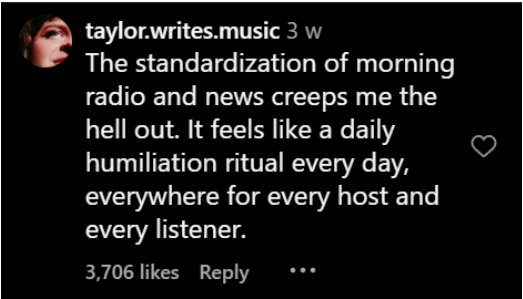
Instagram comment on the video.
Q: It seems that listeners are tired of the lack of variety and personalisation offered by mainstream radio – it makes them feel bored at best, and demeaned at worst. To combat this, what measures does MDFR take to ensure its programming is well-curated?
NAT: ‘When MDFR first started, we did questionnaires asking listeners what songs they wanted to hear. We’re continuing this now by asking our social media followers for their favourite songs of each genre and/ or mood – for example, their favourite relaxing songs.’
‘Around 90% of MDFR’s music is from between the ‘30s to ‘80s, as that is generally when our average listener would have been in their “memory bump years”.’
The term “memory bump” refers to the stage of life when our strongest memories tend to be created. As we undergo the significant physical and interpersonal growth that takes place between the ages of 10 to 30, our self-identities begin to take form. This period of life is often defined by a myriad of “firsts”: first kiss, first job, first break-up, and so on. According to an article by the BBC, listening to our favourite music releases high levels of dopamine and oxytocin in our brain: the same “happy chemicals” triggered when we partake in other pleasurable activities. Since our memory bump years are our most formative, and since music evokes profound neurological and emotional effects, researchers have theorised that the music we listen to during this period of time leaves the longest-lasting impact on our memories.
NAT: ‘I find ‘90s metal very nostalgic – and even pop music, which I hated at the time, now gives me that same feeling. Similarly, my mum never really spoke about ‘50s music; she was mostly into ‘60s and ‘70s rock. But when I’d play music from the ‘50s, which is when she would’ve been quite young, she’d sing along to it and her mood would be lifted.’
‘Another way we ensure our broadcasting is well-curated and dementia-friendly is through our programme scheduling. There are reasons why we play certain presented shows at specific times of the day.’
‘We used to play a mixture of music on shuffle all day: from classical, to ‘30s through to the ‘80s. We realised it was jarring for listeners to hear so many different eras and genres and production styles one after the other, so we decided to break things up.’
In the morning, MDFR plays what Nat termed “rousing music”, aiming to motivate listeners for the day ahead. 6am is for mellow orchestral pieces, which then transition to the breezier, more-dynamic tunes played during “Classical Hour” at 7. From 8am until 9, the station plays a chronological stream of songs from various musical eras. This begins with the ‘30s and continues to the ‘60s.
NAT: ‘The tone and timbre of these eras aren’t too jarring; might be a bit crackly, but there are generally no distorted guitars or massive drum solos.’
‘Then, typically, there’s “‘70s Hour” at 10am. The production style of this era consists of wider, bigger sounds – so, again, it’s trying to make sure our listeners are feeling awake in the mornings.’
‘11am is the only hour where there is a presented show everyday. For this time-slot, we aim to appeal to a wide range of listeners – we’ve chosen presenters who play a variety of musical eras and genres. The presenting style is also livelier; they may do some light trivia for the listeners, as an example.’
‘People living with dementia may struggle to regulate their days, so by scheduling shows that are more energetic at 11am, the idea is to encourage our listeners to get up and ready for lunchtime. In day centres and care homes, where residents would likely be in communal areas for meals at this time of day, the chatty, question-and-answer style of these shows hopefully encourages some conversation about the music and the memories each person associates with it.’
‘At lunchtime, we chill things out again, as we don't want to be distracting while people are trying to eat. We pick things up a bit after lunch, as people may feel a bit sluggish – between 2pm and 4 is “Feel Good Music for the Afternoon’.
‘Then, we start to take things down from 4 onwards. The thinking behind this was the phenomenon of “sundowning”.’
“Sundowning” refers to the behavioural changes, particularly heightened agitation and distress, that may occur in a person diagnosed with dementia towards the end of the day. Although it is not fully understood why sundowning happens, a range of possible factors – such as unmet physical needs, sensory impairments, hormonal changes, mood disorders, and the side-effects of prescribed drugs – may increase its likelihood.
NAT: ‘Initially, I thought the best way to alleviate the effects of sundowning would be to play relaxing music – but when I spoke to a representative from Playlist For Life, they said it may be better to meet people where they are. You should try to take people on a “musical journey”, a bit like how you would if you did a DJ set, where you bring the mood up and then gradually chill things out.’
‘Then, we relax things steadily throughout the day. We’ll occasionally play little bits of ambient music throughout the small hours, like Brian Eno and Max Richter.’
Q: One of the main objectives of MDFR is to deliver programming that evokes nostalgia and reminiscence within your listeners. How do you ensure your station remains dementia-friendly whilst also incorporating music your listeners may not have heard of, such as ambient and classical songs, in your broadcast?
NAT: ‘When I first spoke to one of our presenters, Roger Hill, about joining MDFR, he said he wasn't particularly interested in playing music for reminiscence and nostalgia purposes – which is obviously one of the station’s main purposes – but that he believes that people living with dementia can still enjoy, and benefit from, new and unfamiliar music.’
‘Roger has over four decades of experience in radio presenting, and he’s also a musician himself. He used to do a show on Radio Merseyside where he’d play both local music and more experimental stuff.’
‘Roger is extremely thoughtful when it comes to music; the way he contextualises the songs he plays on his show is simple but beautiful. He played a Brian Eno song one time, and rather than talk about how it was “pioneering” or “avant-garde”, he said: “That was a really floaty piece of music wasn't it? I hope you liked it.” Rather than showing off to people or patronising them, he's trying to democratise experimental music.’
‘Another one of our presenters, Lucas Ruggier, has a similar approach. He plays songs from older genres –
like bluegrass, jazz, and classical – but he’s also played trip-hop and more modern R&B.’
‘Something people perhaps don't think about is the way that production style can evoke nostalgia. Lucas generally plays stuff that has the sound of an older production style, since it may have been created using certain equipment or techniques, but has actually been recorded in recent years.’
Q: In the reel’s comment section, the complaints people had were, funnily enough, about the aspects of mainstream radio that MDFR does away with.
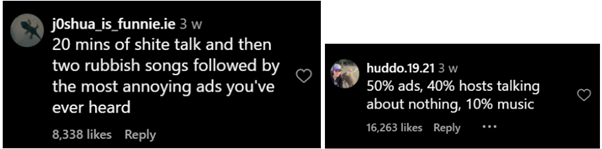
Some spoke about their dislike of radio adverts
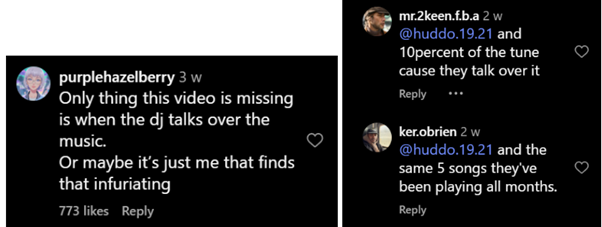
Many also notes their frustration with DJs talking over the songs
These comments show that MDFR doesn’t necessarily just appeal to those living with dementia. I’m curious to hear if you’ve ever had feedback from MDFR listeners who aren’t diagnosed with dementia. And if so, why do you think the station appeals to them?
NAT: ‘That’s interesting. There's a function in the recording software we use that allows you to pinpoint when vocals begin in a song, since most DJs talk over the intros. The idea behind this pinpoint function is that it makes things more cost-effective: by getting the songs over and done with, radio stations are able to play more adverts (or news) and make more profit.’
‘We don’t tend to use hitpoints, because firstly, the intros and outros are important parts of the song too! Secondly, if our presenters want to create a more relaxing mood, we encourage them to include a brief pause between the beginnings and ends of songs.’
‘In the past, we’ve received positive feedback from workmen, taxi drivers, and lorry drivers, who’ve said they enjoyed the decent variety of music we play. I think the main appeal of MDFR to these groups is the no-news and no-adverts, as well as the gentle and relaxing nature of our programming. We actually hope to get the message about MDFR out to more taxi companies.’
This is a perfect example of the ‘curb-cut effect’ [sic] in action: the idea that initiatives designed to help vulnerable groups often end up benefiting all of society. The term originates from the fact that kerb-cuts were originally made for wheelchair access, but are now also welcomed by people pushing prams and luggage.
Throughout history, grassroots activism has been foundational to instances of the kerb-cut effect: ordinary people, having banded together with the aim of addressing issues affecting their communities, have ended up enacting changes that have rippled throughout society. It was thanks to the work of a group of Berkeley-based disability activists in the 1970s that kerb-cuts became a ubiquitous feature of US urban planning; MDFR’s studio, likewise, is powered by a team of local volunteers, whose work preceded the inception of other dementia-friendly radio stations in the UK: Deepness Dementia Radio, m4d Radio, and Memory Lane Radio. The creative freedom and level of curation afforded to MDFR’s voluntary presenters not only enables the station to adopt dementia-friendly broadcasting features, but sets MDFR apart within a radio landscape oversaturated with corporatised programming, repetitive playlists, dull presenter-talk, and incessant advertising.
In the process of giving up their time to provide essential support to those living with dementia, MDFR’s voluntary team also offers what mainstream radio lacks, but what radio listeners of all demographics wish for: authenticity. The station is a testament to the fact that when we work together to improve society for our most vulnerable, everyone benefits.